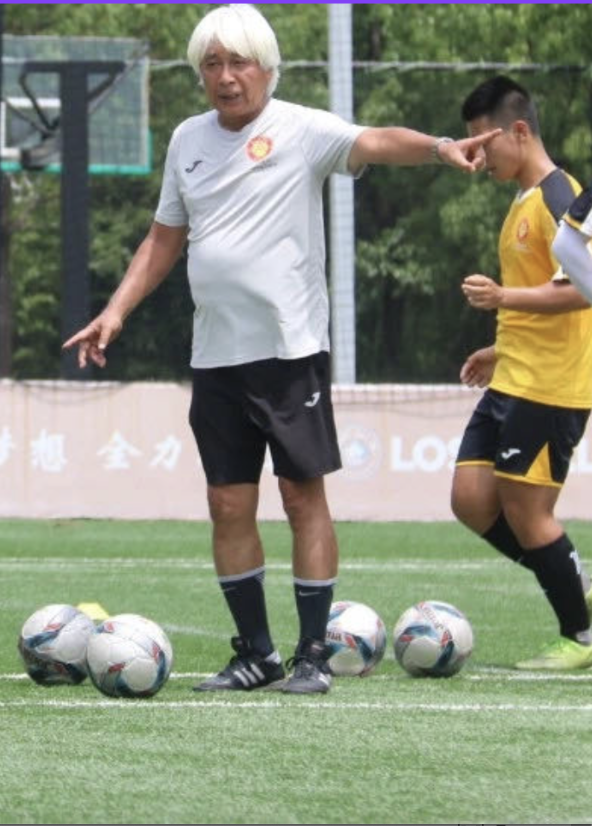
Coach Kaneko is a world-class coach with decades of experience coaching all levels of soccer—from professional clubs to youth clubs.
Thank you for your hard work in playing 12 games over 5 days under the scorching sun.
I think the children had a variety of experiences. However, please don’t just finish the game and ask him about what he did and didn’t do at dinner tonight. Instead of arguing about what you couldn’t do, stand by your child and listen to what they have to say.
Please think together of ways to make it possible. At the same time, I want you to think about what you were able to participate in or not during the 12 games. I talked to the kids about it, but at this age, all you have to do is improve your skills. Even when practicing passing between teammates, they can’t stop the ball well and end up kicking it in the wrong direction. There’s no way you can use that kind of technique during a tense match or under pressure from your opponent.
There is only a small difference on an individual level from the team we played against this time. As a team, we are at the same level as Japan 40 to 30 years ago. Problems such as being weak, running slowly, or not being able to kick far are irrelevant at this age.
Soccer around the world is rapidly evolving, but one thing that remains the same is technology. Stop, kick, carry, steal, and dodge. There are only two or three years left to acquire these skills. I hope that you will be conscious of improving your skills during this important period.
It’s important to be able to do it voluntarily, not just because you’re told to do it. Please talk to your child and encourage them.
40 years ago in Japan, coaches taught players every step of the way, depriving players of their ability to think and make decisions. However, since then, Japanese soccer has been able to develop through coaching that emphasizes technique, leads to discoveries, and never stops thinking. Even if it works within China, it won’t work in Asia. What works in Asia doesn’t work around the world. I want them to learn the real thing in their future training, not fake or accidental techniques and personal tactics.
Thank you very much for your help and support during the intense heat. Please continue to watch over your children’s growth.
Thank you very much, and thank you for your hard work.
In the AFCU 17 Asian Cup Thailand 2023 quarterfinal held the day before yesterday, the Japanese team defeated Australia 3-1, advancing to the top four of the tournament and qualifying for the FIFA AU 17 World Cup.
If you think about it, the tournament was established in 1985, but Japan wasn’t able to participate in four tournaments and made its first appearance in 1993 when it was held in their own country. However, they struggled in 1997, 1999, 2003, and 2005, failing to make it through the Asian qualifying rounds.
Five years before I became the Japan Association’s coach, reforms in training progressed, and we were now able to qualify for the Asian qualifying rounds. Although he did not participate in 2015, he has participated every time since 2005. Naturally, at this age, players aim to win, but this is not the time to compete based on physical ability or tactics. During the period when Japan was unable to participate in the world championships, they tried to win with their physical ability despite their lack of individual technical tactics and made the mistake of trying to win.
In fact, in the 18 times, this tournament has been held, Nigeria has won the tournament the most times, five times, and in Europe, which is crowded with powerful countries, France, Switzerland, and England, each have only won once. In addition, very few of the players who were outstanding players or top scorers in this tournament went on to play for the A national team.
Fortunately, out of the 16 players on the U12 and U13 national teams I coached, two became A players, and six became J-League players. However, eight others considered talented at the time ended up in high school or college. There may be various reasons for this, but the nurturing and growth process after this age is especially difficult.
Later, as a coach for the Japan Association, I was involved in the National Training Center and saw many players, but I was reminded once again of the need to assess and guide the growth of individual players, whether they mature early or late.
Ultimately, it’s important to first develop children who can play soccer.
Approximately 60% of our body is water. If you weigh 60 kg, you will be storing 36 kg of water in your body. It can be said that “human beings are made of water.” This water in the body is called “body fluid.”
People lose water through sweat in various everyday situations. Sweat has an important role in keeping body temperature constant. When your body temperature rises, you sweat because when sweat evaporates, it removes heat from the surface of your body and cools you down. Sweat keeps our body temperature constant, which allows our bodies to function normally and keep us healthy.
Water (body fluids) in our bodies plays a very important role in our bodies:
1. Transports nutrients to every corner of the body.
2. Excretes unnecessary garbage (waste) from the body.
3. Regulate body temperature.
Even though we live a normal life, we lose 2.5 liters of water a day through urine, sweat, and breathing. On the other hand, the amount of water that comes in from drinks and food is also 2.5 liters per day. Therefore, body fluids are always kept at a constant level. The reason you feel thirsty when you sweat a lot is because your body tries to restore the fluid you lost.
However, sweat contains ions in addition to water. Even if you drink water, the water (body fluids) in your body does not recover sufficiently!? What is spontaneous dehydration? When rehydrating your body, drinking only water may have the opposite effect. If you continue to drink only water, your body tries to maintain a constant concentration of body fluids, causing excess water to be excreted from your body as urine. As a result, a phenomenon occurs in which the amount of water in the body cannot be recovered sufficiently (spontaneous dehydration).
At the same time, in order to prevent the concentration of body fluids from diluting any further, there is a risk that your thirst will subside even though you have not recovered from dehydration, and you will not be aware that you are dehydrated.
It is said that it is a good idea to drink half a glass of 100ml before exercising, and during exercise, drink 3 sips of an ionized drink at a temperature of 6 to 8 degrees Celsius.
There are children who drink more than 1L during one practice session, but this leads to the drop in body fluid concentration that I mentioned earlier.
It’s not enough just to drink water, so I would like to continue to provide proper guidance on hydration.
Our profession as coaches is an unproductive profession. It is not directly connected to daily life, such as growing crops, catching seafood, measuring quantities, and making things. For those who are not interested in football, it is possible to live without it.
The same goes for players. In a sense, it’s a blessing to be able to make a living from football. After all, football is just a game, and people often think of it as a way to make a living. When my grandmother was alive, she used to tell me, “Don’t do boring work. Do something that helps people.”
However, I think this way. There are limits to human ability. We believe that challenging these limits can improve human potential. In the 100m dash it has been the world record for 15 years since Jim Hines, the first human in human history to break the 10-second barrier with a time of 9.95 seconds, at the 1968 Mexico Olympics, and the current record is Usain Bolt’s 9.58 seconds in 2009. It is still unbroken.
However, there are countless athletes who attempt to set records in marathons, swimming, and track and field. In the case of football, records are things like the number of goals and wins, but it is the content that stays in people’s memories. And it is the content that moves and excites people.Football players are also athletes who continue to challenge their limits.
I believe that this attitude of challenging one’s limits can be useful for, for example, studying, research, and development, even if one cannot become a top athlete.
Since coming to China, I have always made new discoveries, and have continued to explore new coaching methods and football
“Watching” is an essential action in playing football. If you don’t watch it, you won’t understand the situation and can’t make a decision. The problem is understanding why you should watch it. If you don’t understand when to watch, how to watch, and what to watch, you won’t be able to play well.
When crossing a crosswalk, you will look at the traffic lights, check for cars and motorcycles, and consider the distance and time it will take to cross.
If you don’t look at anything or think about anything, you’ll get into an accident, and in the worst case scenario, you’ll lose your life.
In football you don’t lose your life, but you do lose the ball. “Watching” is essential to not losing or stealing the ball. A situation in which the passing path is blocked by an opposing player, or where the opposing players are crowded together, is a red flag. A situation where there is space and the passing path is open, but the opponent is approaching, which means a yellow light. If you dribble or pass in that situation, it’s obvious what will happen.
In football in the 1960s and 1970s, players had about five seconds to receive the ball. In the 1980s and 1990s, it was around 3 seconds, and now it is around 1 second. Data shows that Messi can make decisions within one second. He has many options, is quick to make decisions based on what he sees, and has excellent predictive and reflective abilities.
“Less time, less space”
Modern football is growing even more.In other words, I always think that speed of nerve transmission ability is necessary.This is the basics, and if you develop more creativity, you will become a better player.
Daily effort is important.
In sports, not just football, nothing can be completed with just one movement. Advance preparation, preliminary actions, and post-actions. The upper body, lower body, right body, and left body each move separately and must be connected.
There are many people who perform one movement and then take a long time to move on to the next. At their age, the nervous system is reaching the end of its development. If we miss this period, we will not be able to create new neural circuits and will only be able to use our original and inherited nerves.
I think people will understand that they need to develop the nerve to handle the ball like their hands, while their legs are used only for standing, sitting, walking, and running motions. Furthermore, a thought process is required to determine what kind of movement to perform using the feet.
Even if you don’t play football, you can develop this way of thinking in your everyday life, and I want you to have a variety of movements and thoughts that you can use not only in football. Developing people who can also play football.
There is a reason why Japanese athletes are able to play an active role in a variety of occupations after retiring.
As I have said many times, in football, you spend very little time touching the ball and a lot of time without it. In other words, you need to move and prepare when you don’t have the ball. Before the ball arrives, players need to look around, check the location of the ball and goal, their teammates, opponents, and space, and be prepared to increase their options for the next play.
I often see parents helping their children prepare, not only in Step Up Class 1213, but also in other Enjoy Classes and classes other than Chino Rui. In some cases, I may not be able to have children, but I help out with whatever I can.
Children who are not prepared naturally do not even prepare for football and kick the ball on their own. The worst thing to do is for the child to not understand how to prepare themselves, or for parents to put the responsibility on the child even though they have prepared.
When I watch such children train, I transfer my own failures onto others. He also blames the opponent who missed a pass or failed to catch it. They don’t try to do what they can’t do, ask for help from others, and don’t make an effort because they can’t take action on their own.
Development of independence “own circumstances”. His attitude in everyday life is also reflected in his football.
There are successes and failures in everything. In a sense, what you can do becomes possible through repeated failures. Success comes from the beginning, and the things you can do may be simple, or you may be extremely talented and talented, so-called geniuses, or it may be by chance.
Many people keep trying and trying even if they fail and reach success. As I get older, I feel like I don’t have enough time to really focus on things. When I was young, I sometimes thought that I had infinite time, and that I wasted it.
In the world of sports, records have been broken through the efforts and challenges of various people. The same is true in the world of science. There are countless examples of events that led to success through insatiable inquisitiveness, effort, and repeated failures.
It’s easy to think you can’t do it and give up. However, it is clear that there will be difficulties in the future. If you don’t do anything and just waste your time just because you can’t do something, you won’t be able to succeed or grow.
We adults have learned how to succeed through various experiences. However, is it okay to simply pass on that method to your child? And is it really a good thing for a child to be able to succeed without making any effort or trying, even if you tell them? I think it’s very important to keep trying, even if you can’t do something. Even if you don’t achieve success, your efforts will be valuable.
Because they can’t do it, they are spoiled and adults help them. I also want children to understand the dangers of doing nothing and abandoning efforts and challenges. Words from inventor Thomas Edison: “Failure is the mother of success”.
Do you choose not to fail and do nothing, or do you choose to imitate other people’s success methods? Will you choose to continue to strive and take on challenges? I also want to work hard in the time I have left.
I think we had a very meaningful time in this match in Wuhu City.
I hope that each of the children will feel what they were able to do on their own, what they tried but couldn’t do, and what they were unable to do.
If you slack off and do 60% during your regular training, there’s no way you’ll be able to give 100% in a match. “Training never lies.” What I couldn’t do in training, I couldn’t do in games either.
However, I believe that there was a child who was able to maintain his desire to work hard throughout the match, and that he took a new step toward future progress.
Failure in training has no effect on the outcome of the day. Failure in a match can lead to points being conceded and even result in a loss. I think it’s important to get caught up in successes and failures right in front of you, and how you feel about the impact on the whole, your colleagues, and others.
However, as I wrote the other day, I highly appreciate his efforts to challenge himself to things he is not good at and demonstrate what he has cultivated through training. There will definitely come a time when this effort will be rewarded if you continue.
Thank you for your hard work over the 5 days. Please listen to the details of the game, what they did and didn’t do, and what they will do in the future.
This is a technical issue that I have talked about several times.
Kick, control, dribble, tackle, stand.
Among these, what tends to be neglected is the technique of tackling.
When I look at the children, I often see them doing nothing but kicking the ball that their opponent is holding.
In some cases, you may have to stop your opponent’s attack. However, simply going to kick the ball is merely stopping the opponent’s attack rather than stealing it. If you’re lucky and the ball touches your opponent and goes out, you might be able to turn it into an attack, but that’s just a coincidence.
Naturally, I think they lack the awareness to reliably steal the ball and turn to attack. To capture it, you need to get into the right position. This also means “standing,” but in order to do that, you need skills to take a position according to your position on the field, distance to the opponent, and the opponent’s situation, as well as individual tactics.
Players who understand that football begins with a scramble for the ball will improve quickly.
What truly is athletic ability?
1. Sensory organs such as eyes and ears recognize information such as the movement of balls and people. During exercise, information is often obtained visually.
2. Information is transmitted to the brain through nerves.
3. Based on the information, the brain gives instructions on how to move the body appropriately.
4. Instructions are transmitted to muscles through nerves.
5. Muscles in each part work according to instructions from the brain to move the body. High athletic ability (good athletic nerves) means being able to do this flow appropriately and accurately.
Through further repetition, it is necessary to improve the ability to see and react through spinal reflexes without going through the brain. In other words, seeing and feeling are important, but training without watching or listening will not produce good neural movements.
Are children really watching and listening?
Respect.
What I think is important.
We believe that the essence of respect is to always play to the best of your ability, and that this is the origin of fair play. I would like to capture it in the context of all the relationships surrounding football, such as teammates, opponents, referees, coaches, equipment, facilities, parents, tournament officials, supporters, competition rules, and the spirit of the game of football. I think it’s something that is important.
And what is fair play?
1: Accurately understand and follow the rules
The basis of fair play is to be fully aware of the rules and to make an effort to abide by them.
2: Spirit of rules: safety, fairness, and joy
The rules are designed to allow you to play safely without injuring yourself or others, to be fair to both teams and players, and to allow everyone to have fun while playing. It’s never about giving yourself the upper hand.
3: Respect the referee
The referee is a person appointed to ensure that both teams can play fairly according to the rules. He is a human and will make mistakes, but since he is the one who has entrusted the final decision, he must trust the referee and respect his decision. Referees are also recognized as fellow football players.
4: Show respect to others
Players from the opposing team are not the “enemy.” He is an important “friend” who enjoys playing football. Players must never play in a way that could injure their teammates.
There are only 17 rules in football.
If people have different interpretations, football will not work. Don’t neglect your efforts to know the rules.